Update 19 - September 2026 - Autumn Update
It’s been an exceptional summer for the Blackbushe Heritage Trust with the highlight being the arrival of ex Royal Air Force Vickers Valetta VX573 ‘Loreley’ which arrived by road from RAF Cosford late on 18th June. Out of a total of 263 Valettas just two complete aircraft remain, so it is a huge privilege to have been gifted VX573 by the RAF Museum. The aircraft, a later C.2 variant with a strengthened floor and large freight door, flew for just under 20 years in a VIP role with RAF Germany. The last operational flight was into RAF Northolt on 2nd November 1968 and just 5 days later it flew into RAF Henlow for storage by the RAF Museum. In 1979 it was transported by road to RAF Cosford where it remained, mostly hangared, for nearly 40 years. It is the only Valetta to have served its whole operational life overseas and was the only Valetta to have been employed on the same duty in the same command throughout its career.
The journey to Hampshire carried out by CCG Commercial Ltd went smoothly and the three lorries arrived at Blackbushe around 9pm on 18th June. A long unloading process went on well into the early hours of the following day before BHT volunteers took over and began the complicated process of reassembling the aircraft. Our Tech Team have amassed much experience previously whilst working on our Vickers Viking G-AGRW ‘Vagabond’ (the Valetta is the military version of the Viking) so as a result it was put back together in just 4 weeks, a huge achievement and a credit to all involved.
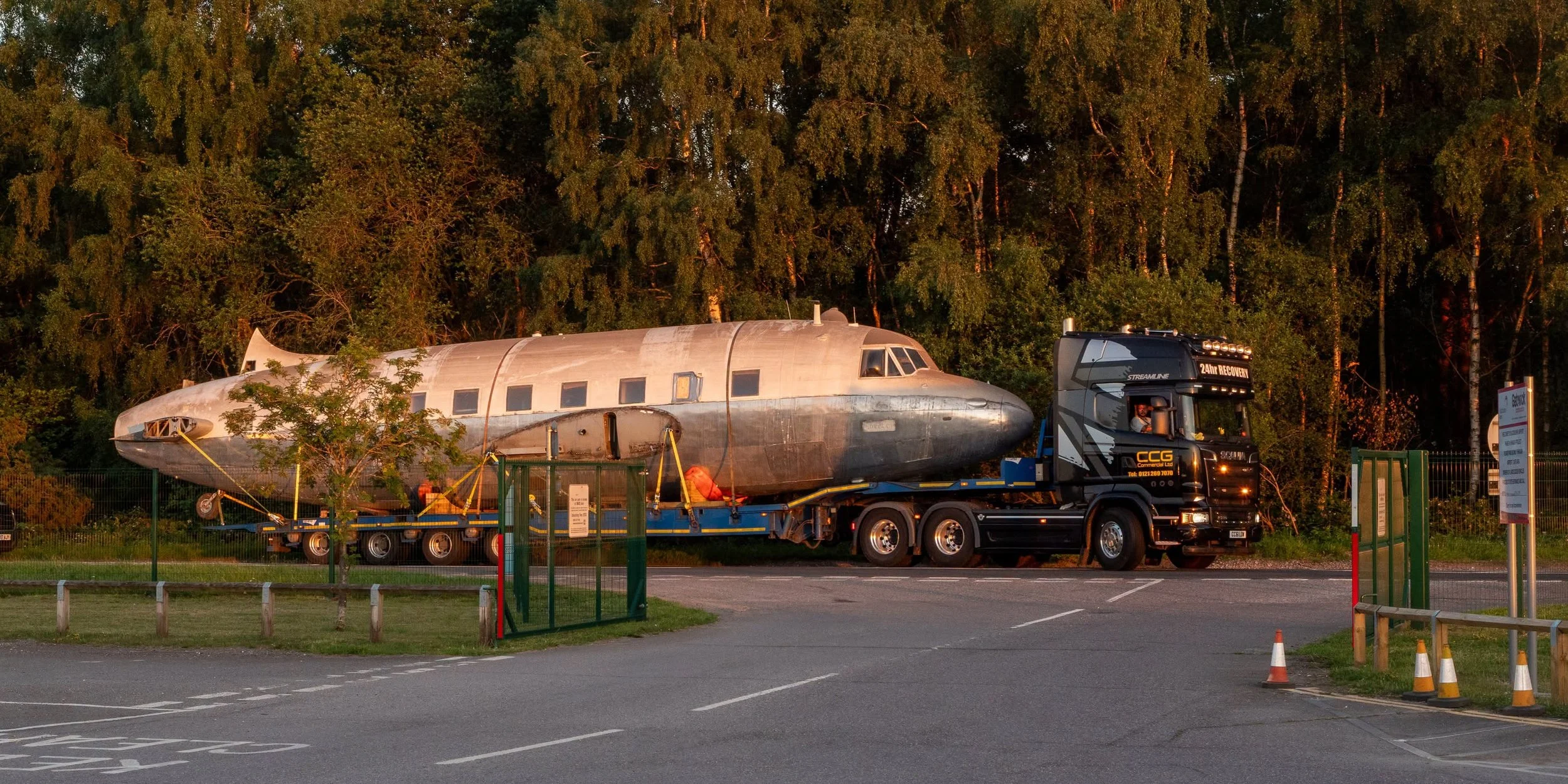
“Loreley” arrives at Blackbushe on 18th June
Having been hidden away from the general public for so long it was no surprise that “Loreley’s” debut at our Vagabond 80th Birthday event on 25th July proved to be very popular. This event marked 80 years since “Vagabond’s” first flight, which actually occurred on 27th July 1946, and was a great opportunity for us to showcase what BHT has achieved in just 4 years since we set out on our exciting journey. A focal point of this celebration was the unveiling of a new memorial plaque to Air Vice Marshal Donald Bennett, who saved Blackbushe and re-opened the airport in 1962. More details on this are contained in the “Events Team” update below, amongst other contributions from some of our “lead” volunteers and Trustees.
Tech Team - Phil Stonard
Late Spring saw activity ramped up with part of the team conducting a number of multi-day visits to RAF Cosford to dismantle “Loreley”, where we were also very grateful for assistance from RAF Museum staff. The re-assembly at Blackbushe was carried out in record time with the aid of CCG Commercial Ltd. and their lifting expertise and capability. It was not without a few challenges over the period, including having to fabricate some special tools, but it is now an impressive looking exhibit on site and an example of BHT’s own capabilities.
This has not stopped work on “Vagabond” with continuation of “normal” activities albeit at a slower rate. Both inner wings and nacelles have been fitted and the fillet panels (edging strips) are ongoing work. Engine cowlings are undergoing paint strip and repair where necessary and extensive work on rudder and tail fin parts continue.
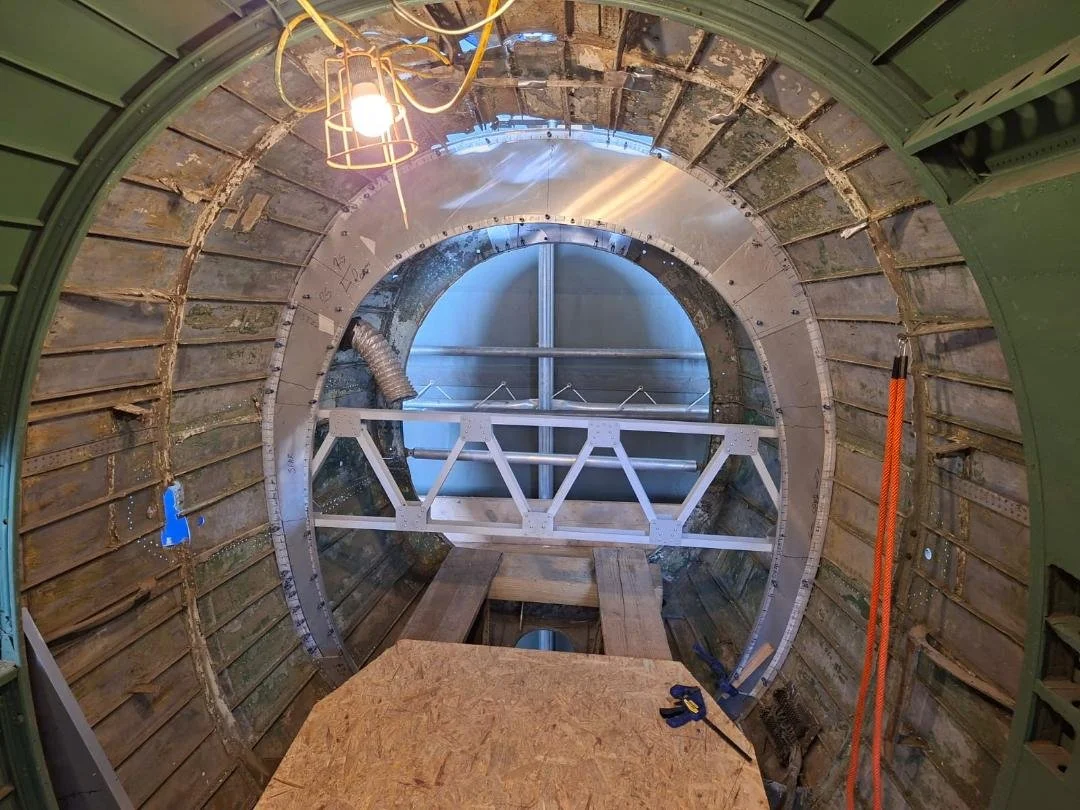
A new tailplane spar has been fabricated (see 1st picture below, which shows the new spar being trial-fitted into the fuselage) and together with significant rear fuselage work will restore structural strength in that area once married together in due course. Further forward there has been work on interior and cockpit instruments, see below. A multitude of small parts such as access panels are being repaired or replaced with many more remaining.
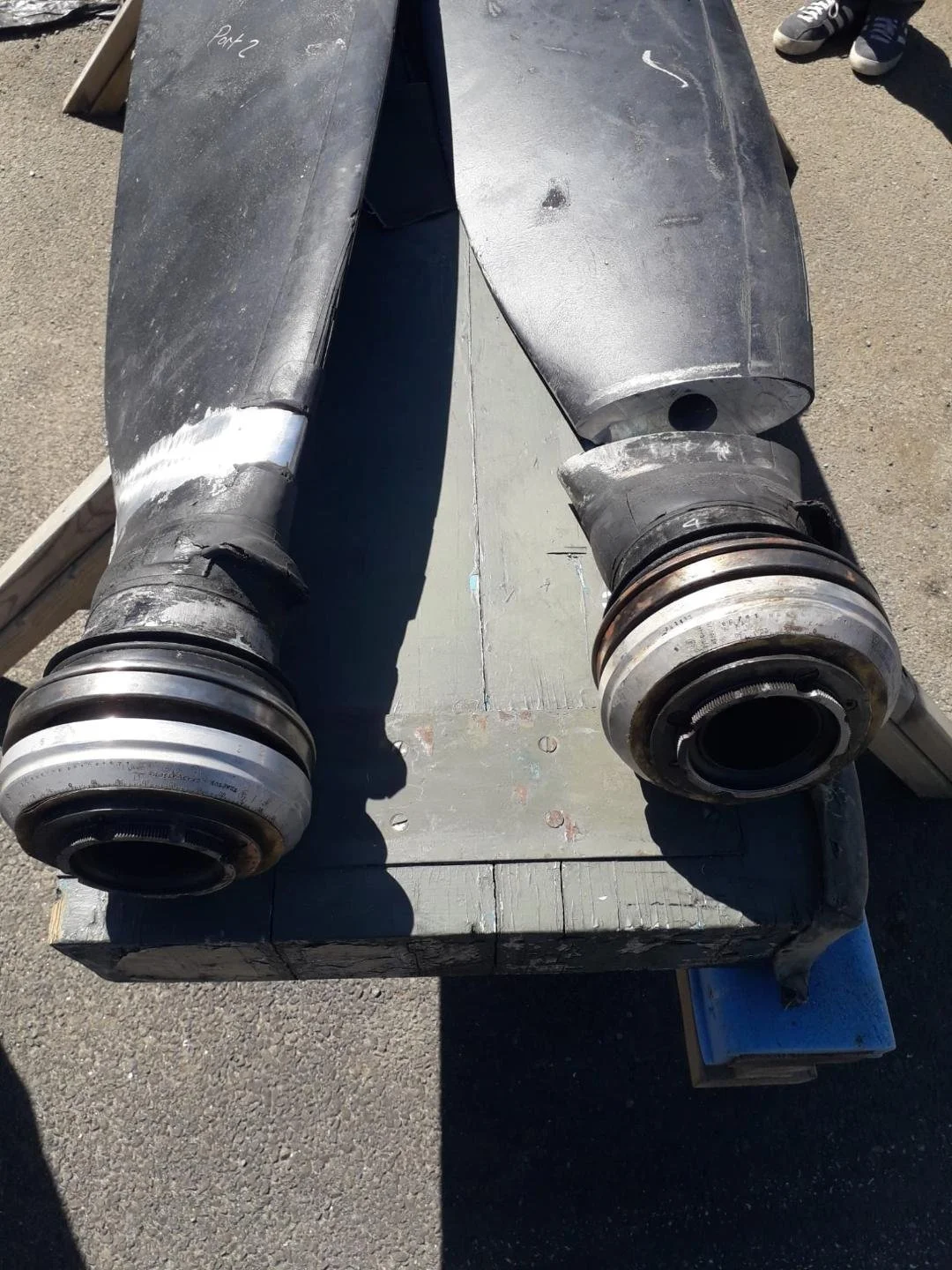
One propeller blade was despatched for significant welding repair which proved very successful (see 2nd picture below, the left-hand blade having been welded back together). We hope to progress with the three others that need similar attention at a later date. At the same time the aluminium rudder brackets for “Loreley” were also repaired, enabling the aircraft assembly to be completed. One mainplane has also recently been turned over to enable paint strip of the underside.
The Tech team were also heavily involved in event preparation for the “Vagabond” 80th celebration, making display boards and applying a temporary scheme to “Vagabond’s” fin. So in all a very busy period with the main focus now returning to “Vagabond” as we approach mid September.
Cockpit Team – Richard Faint
At the time of writing, the instrument panels are now cut and will be delivered to Blackbushe in a few days. They will then be powder-coated ready to accept the instruments prior to being mounted in the aircraft. Work is currently underway on the windows to eliminate the current issue of leaks when it rains.
In the meantime, work has continued on ways to mount the panels. Fortunately there are three original fixing points still in the aircraft which provide a valuable reference for the correct positioning of the panels. Later this month, I am visiting another of the six surviving Vikings globally, G-AIVG in Switzerland to examine how the panels are attached on their aircraft, with a view to recreate the same mounts for Vagabond.
The Cockpit Team have also been providing technical support with “Loreley’s” completion by sourcing various instruments to fill the gaps in the cockpit. Parts of the aircraft's Decca navigation have been sourced from far and wide, including a rare Flight Log plotter found in Europe.
Events Team – Mark Griffiths
Our fantastic Shop and Events team have endured some extremely hot days this summer both at Blackbushe during our regular Sunday shop openings and by representing BHT at a number of events. They have introduced us to many members of the public, explained how we have evolved over just four years and our exciting aspirations for the future. Our collection of merchandise sells very well, whether it is key rings, mugs, pencils, baseball caps or our very popular Viking “Reflections” book, all of it ensures we keep the funds coming in to continue our restoration of “Vagabond” and looking after recently-arrived “Loreley”.
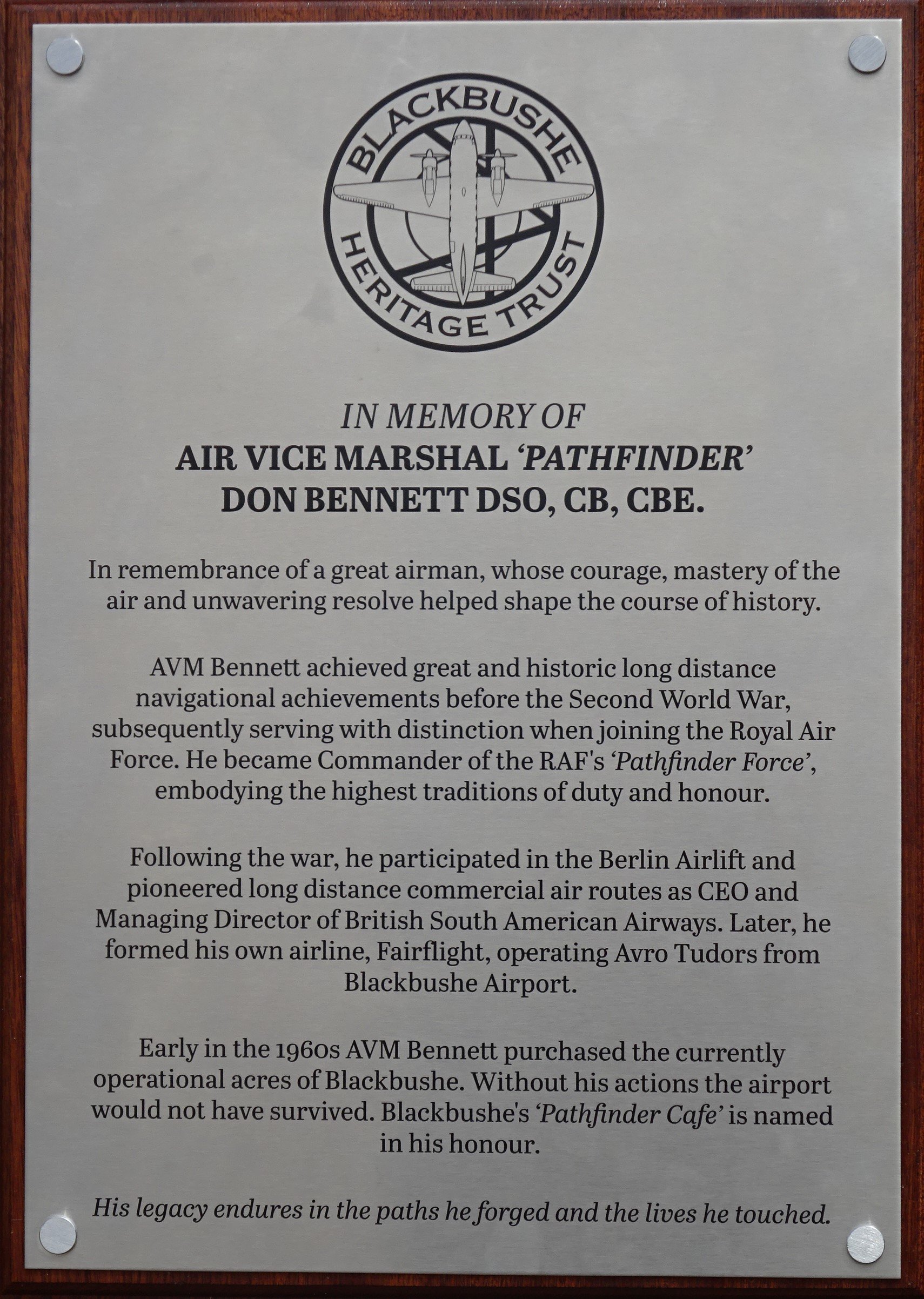
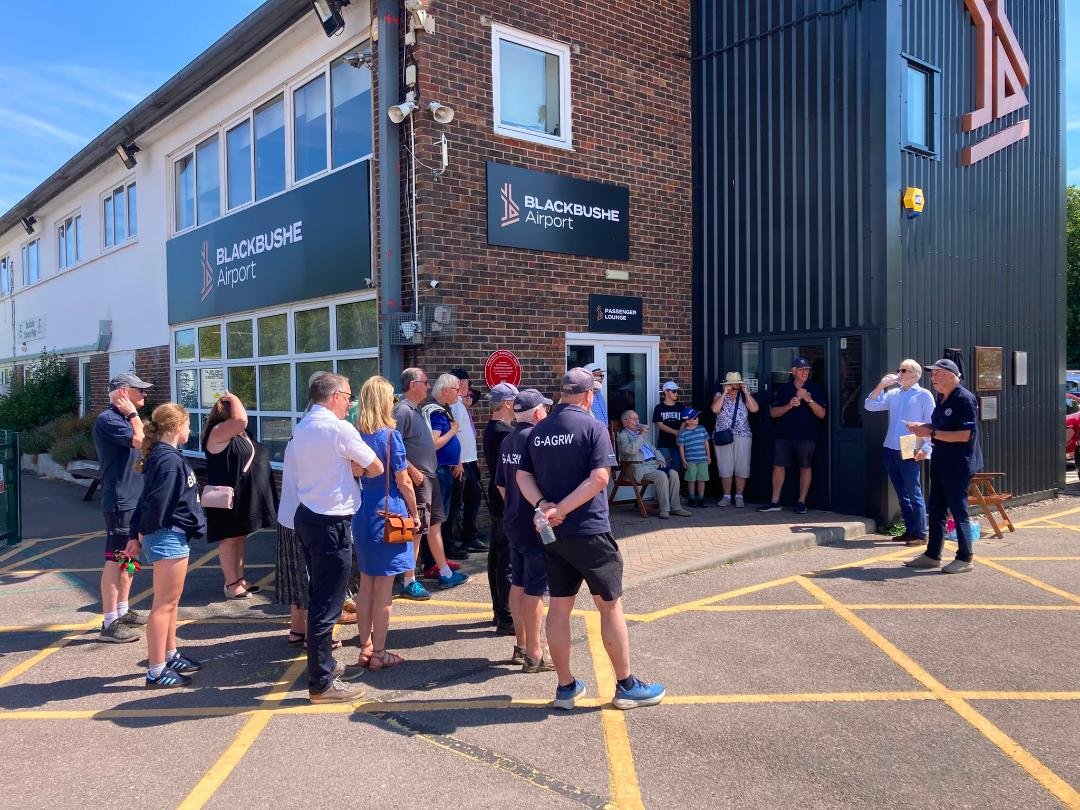
We were privileged to welcome back to Blackbushe Flight Lieutenant (Ret’d) Colin Bell to be part of our “Vagabond” 80th Birthday event. During WW2 Colin flew the RAF DeHavilland Mosquito with 608 (Pathfinder) Squadron having been based briefly at Blackbushe in the late 1940’s. We could have chosen no one better than Colin to unveil our new memorial plaque to the Commanding Officer of the Pathfinder Force, Air Vice Marshall Donald Bennett. His role in the famous Pathfinders is well-documented but less so is his involvement at Blackbushe in the late 1950s/1960s.
Seeing how the Government had abandoned Blackbushe Airport in 1960 , he knew from experience the many benefits the airport would offer as a general aviation site less than 40 miles from central London. He set about purchasing around three quarters of the airport from Calthorpe Estate and Blackbushe was officially reopened in October 1962.
The memorial plaque (shown in the first picture below) joins the growing collection which have been re-attached to the Control Tower after a coat of paint and with the striking new airport re-branding being applied. We hope many people will stand here and reflect on the history of Blackbushe and the sacrifices made by so many at our local airport.
The full speech that Chairman Peter Brown read out during the unveiling is attached below this Newsletter. The second picture below shows the reading and plaque unveiling in progress at the base of Blackbushe’s Control Tower.
Virtual Reality – Alexis Holding
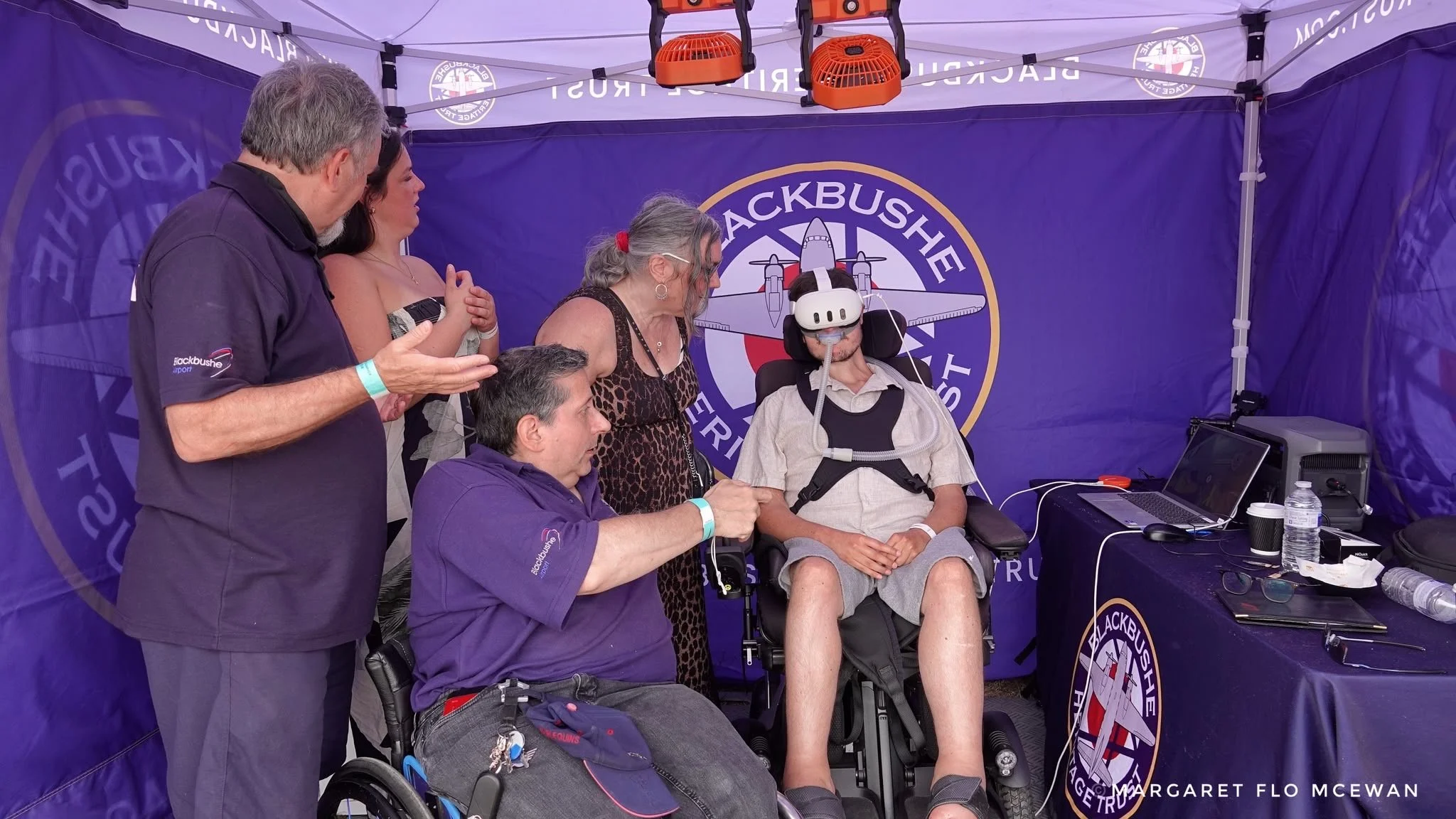
It was great to be part of a very successful British Airways staff event at Wycombe Air Park on 4th August (the picture below shows our VR stand at the event with a virtual aircraft tour in progress). We had a lot of interaction from the visitors which was good to see. We had the same challenges as before at external events in that we rely on an internet connection for the system to work and had to use one of our vouchers for the mobile hot spot. However the newly-acquired solar powered power bank proved invaluable.
Moving forward we have been thinking about how we can progress onto the next step using the Virtual Reality (VR) headsets and have decided that there will be two different ways in which to do this.
The current way where we pay for someone to undertake a scan which enables the user to self-navigate around the aircraft. One thing to note is that we probably will not pay for a new scan for some time until there has been significant progress on the restoration of “Vagabond”. Most probably we will wait until she is back on her wheels. Each scan costs around £250.
After some research, I have discovered that you can upload files directly to the headsets, so we are currently investigating this idea. Basically, it will mean filming some tours of the aircraft (and other areas of interest) which we can then directly upload to the VR goggles, thus negating the need for Wifi, only power will be required. We have undertaken a quick test using Richard Faint and his GoPro 360 and got the file to play on the headsets in VR mode, so one can turn one’s head and as a proof of concept it works, which is brilliant.
However, we will be undertaking a further trial in the coming weeks to make a better-quality video. A walk through plan will have to be designed, and a guide (from the history team) will have to be appointed who will wear the camera (we have two alternatives) and undertake a guided tour of both aircraft. We will then edit the video and upload it to the headset.
If this further trial works then the scope is endless, for example one of the Tech Team could wear the camera whilst undertaking some of the restoration and this can be uploaded to the headset and give the viewer a first-person view of the work they are undertaking. This fits in well with our STEM aspirations.
Website, Social Media and Media coverage – Kevin Bond
Our website has seen the number of visits increase by 175% year-on-year so far in 2026, to about 15,000. We hope that the ‘Tech’ Blog, which on a roughly monthly basis provides an update on the progress of the restoration of “Vagabond”, now also with coverage of the arrival and rebuild of “Loreley”, has helped to contribute to this increase. One of the aims of the Blog (which now covers the period, year-by-year, since “Vagabond” arrived in May 2023) is to provide views of the ongoing work for people who are unable to visit Blackbushe in person. It also now serves as a historical record of the restoration to date.
The arrival of “Loreley” and the coverage we provided on our social media channels has, we hope, also contributed to views of our Facebook Page increasing by 106% to over 430,000 during the last 3 months (May-August). The number of people who ‘follow’ our Page has also seen a 37% increase, to around 1,800, during the same period. We share our social media activity across local community groups on a regular basis, and also to interest groups for aircraft preservation and restoration. We know from the questions and comments we get that awareness of what we are achieving is reaching an increasing audience.
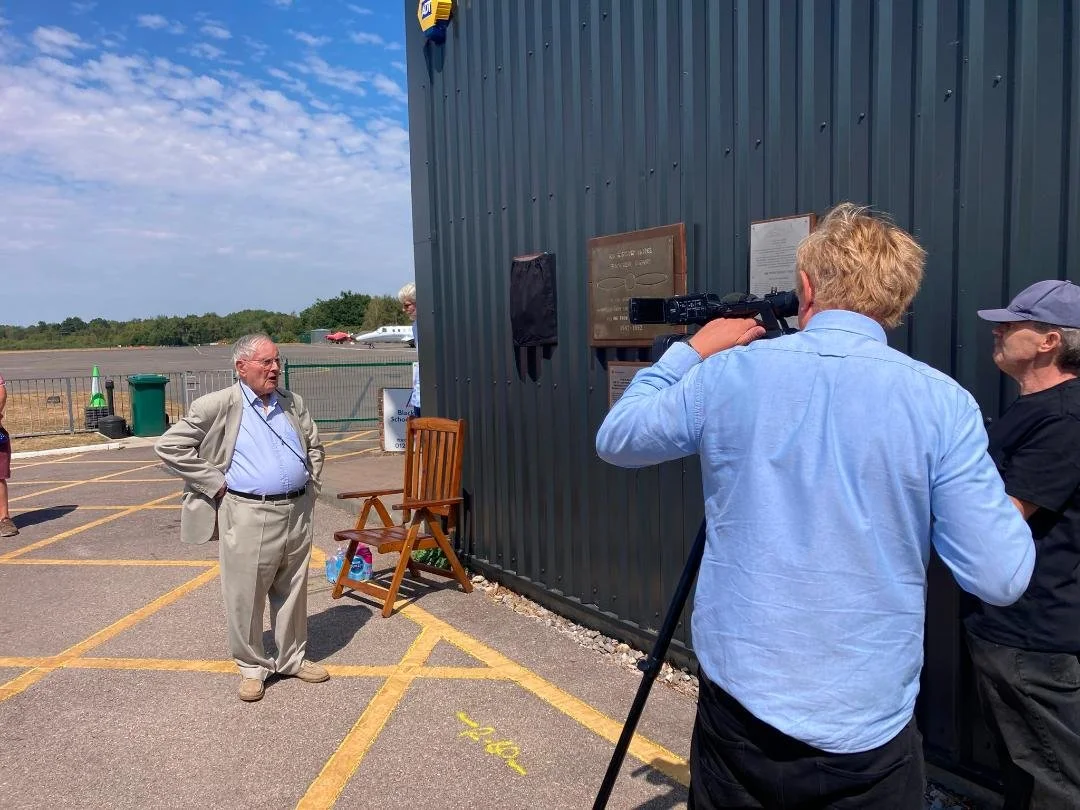
Another great increase to regional awareness for us was BBC South Today's excellent article covering our “Vagabond” 80th Birthday celebration event, which was broadcast on the 31st July. Their reporter, Steve Humphrey, spent the day with us on the 25th July and we hope this won't be the last time we see to him to cover our progress at Blackbushe.
The picture below shows Flt Lt (Ret’d) Colin Bell being filmed at the plaque unveiling on 25th July by BBC South’s reporter Steve Humphrey.
Future developments….
As we move into the Autumn a new vehicle group is forming with a new arrival expected fairly soon and stay tuned for an exciting new smart phone App which will allow users to view old photographs as they walk around the airfield. We would not exist if it wasn’t for the dedicated team of volunteers working in all areas of BHT, all adding to what we are creating at Blackbushe, a fully immersive experience for visitors to one day enjoy. Thank you once again for all your ongoing support in every way.
Best Regards,
Peter, Dave, Pat, Paul, Chris, Becky and Mark - BHT Trustees
Following is the full text of the speech delivered by our Chairman Peter Brown at the unveiling of the plaque celebrating the life of AVM Don Bennett, who saved Blackbushe and contributed to the shortening of WW2, on 25th July 2026
Today we celebrate the life of AVM Donald Bennett, his contribution to aviation, war in the air, post-war air transport, and subsequently the actions taken by him in the early 1960s to acquire and save the Blackbushe Airport we enjoy and benefit from today.
As we prepare to unveil the new plaque commemorating the great man it's best we step back and refresh our awareness of his life and what it means to all of us gathered here this afternoon..
Born on 14 September 1910 in Fairthorpe, Toowoomba, Australia, he was the youngest offour brothers, his life story begins as a country lad raised on a Toowomba cattle farm, going on to become the youngest Air Vice Marshal in the RAF. Life on the cattle ranches as a boy was tough and no doubt founded the 'can do' spirit that accompanied him through life. He would visit his father's cattle farms for weeks at a time, finding life there was quite the opposite to the comforts of life at home. Life in the outback meant sleeping on the ground with a saddle for a pillow and the howl of dingoes for company.
Flying had entered his soul at the age of four when witnessing an American giving a flying display at Toowoomba, he witnessed Hinkler arrive on his historic flight from England, and Amy Johnson's arrival - the first female to complete the London-Australia challenge. Don Bennett wanted to fly too, no question, he WAS going to fly...
His burning ambition was to join the RAAF. Age was a problem, much too young, he thus worked in his father's office to gain working experience and pass the time until his age met Australian Air Force requirements. During these pre Air Force years Don Bennett helped a neighbour restore an aged Farman biplane and also overhaul its engine. From an early age he demonstrated an outstanding aptitude for things mechanical and, of course, read all the flying books he could find.
At last, on a cold and wet Australian July morning in 1930 DCT Bennett, along with fourteen other recruits, reported to the HQ RAAF, Melbourne. Out of very many applicants, just fifteen had been selected. His training commenced at Point Cooke, Victoria. With almost immediate effect his future career pathway changed. The government, as a condition, now required that he and his fellow course members transfer to the RAF on completion of initial training. Bennett had had no desire to travel but very quickly he realised the only thing to do was volunteer for the RAF. At the conclusion of his RAAF training Bennett topped his course in flying! He and his course associates thus travelled to the UK to commence a four year commission with the RAF. Now began the flying career of this most eminent of aviators... he would go on to become the youngest Air Vice Marshal in the Royal Air Force, as a bomber pilot he became the leader of the famous Pathfinders from 1942 to the end of the Second World War. He was described by Head of Bomber Command "Bomber" Harris as "the most technically brilliant airman of the war".
On joining the RAF he was first assigned to 29 Squadron at North Weald, a fighter squadron. He was there only a matter of months before joining 210 Flying Boat Squadron at RAF Calshot and then onto Pembroke Dock where the CO was Arthur Harris who greatly admired the young Don Bennett. It is important to note that during his time at Calshot he waschosen to lecture on navigation, especially long distance navigation being the subject he excelled in. In January 1934 he agreed to fly as navigator in a Lockheed Vega that was participating in the London-Melbourne Air Race. He studied like never before to obtain his First-Class Navigators License and became only the seventh person on the planet to obtain the coveted qualification. Sadly, the aircraft crashed while landing at Aleppo. Bennett was sitting in the back and received serious injuries including three crushed vertebrae. During his recovery three years were spent lecturing at Calshot, in addition to his Navigators license Bennett also studied for and gained a Commercial pilots licence, Ground Engineers Licencescin A, C, and X categories, a wireless operators license, and an Instructors Certificate increadiness for the time when he would enter civil aviation.
Don Bennett left the RAF in 1936 and joined Imperial Airways. There he played a major rolecin the establishment of international civil aviation, and pioneered long distance flights tocAfrica, India and the United States. He flew the first ever commercial transatlantic flight. He personally flew a record-breaking flight in July 1938 flying a Short seaplane from Ireland to Canada and then again in October 1938 from Scotland to South Africa. To this day he holds the long distance seaplane record of flying 9,650 miles in 42 hours...
After the outbreak of war Bennett re-joined the RAF in September 1941 and by December he was already commanding a bomber squadron. By this time the Royal Air Force bomber Squadrons were not achieving the desired results, a new squadron - a target marking Squadron - was envisaged, a unit that would mark targets with such precision that the bomber streams would have no major difficulties in identifying and striking their appointed and ready marked targets. Prior to the Pathfinder squadrons results had been very poor, PR photos showing too many targets undamaged. Bennett envisaged a method that would rectify this unacceptable situation and sowed the seeds of his idea to the highest levels in Bomber Command, an idea that would lead to a select group of path finder aircraft leading raids with the most experienced navigators to mark exactly where the aiming points lay. Despite opposition from some Bomber Command factions the Pathfinders were formed and Bennett placed in command. His experience of flying, navigation, radio, engineering and scientific knowledge suited the role of leader perfectly. The Air Force's youngest Air Vice Marshal in the history of the RAF at 33 years of age had a job to do, a job that would change the course of history. He was driven and utterly determined, he demanded the highest standards from his crews, and he was an inspirational leader.
At this point we'll look at some highlights of the Pathfinders' operations in WW2. They led almost every major raid over occupied Europe. In 1943 they spearheaded the Battle of the Ruhr, the sustained and successful aerial campaign against Germany's industrial heartland while in the same year they successfully marked the top secret Nazi V weapons research facility, severely delaying German rocket development. In 1944 the Pathfinders precisely marked gun batteries, drop zones, and landing areas in readiness for the Normandy invasion. The Pathfinders created the Light Night Striking Force flying high speed Mosquito aircraft. Flying independently or in small groups they carried 4,000lb 'cookie' bombs causing unpredictable chaos, disrupting German defences while also managing to tie up enemy night-fighters. The Pathfinders achieved incredible results, they flew 51,053 sorties. Sadly, as they were first over heavily defended targets they suffered casualty rates at least twice as high as the remainder of Bomber Command.
Here's an astounding quote of appreciation from Arthur Harris, Marshal of the Royal Air Force, "Donald Bennett, who I have known since 1931, was the obvious man available at the time to head the Pathfinders, he was in his early thirties, very young indeed to become a Group Commander but his technical knowledge and his personal operational experience were altogether exceptional, he was a profound student of navigation, he played a major part in planning and executing the transatlantic ferries, the delivery of many new aircraft for the RAF's war effort from the USA and Canada. I then got him back into the Air Force as a Wing Commander. He commanded a Halifax squadron and in 1942 he was shot down in flames over Norway when he was attacking the German battle ship Tirpitz. In his usual gallant manner he escaped to Sweden after many adventures and so nearly losing his life - escaping from the blazing Halifax at the last possible moment. (He kept the stricken aircraft in the air as long as possible to have a second attack on the ship and enable his crew of seven to escape). His courage, both mental and physical was outstanding and as a technician he was unrivalled. All this, of course, is rather unusual in a fighting man and we were lucky to get him, a man of such attainment to lead and form the Pathfinders".
At war's end AVM Bennett resigned his commission in the RAF. His spirit had no intention of taking life more quietly, far from it, he became a Director of British South American Airways, the airline that pioneered long haul air routes after the war. Still an active pilot, the AVM was in command of the first passenger flight to depart the new London Airport now known as Heathrow on May 31, 1946. Flying a Lancastrian named "Starlight" of British South American their destination was Buenos Aires, a trip taking some 35 hours with fuel stops in Lisbon, West Africa, and Brazil.
Following a disagreement with the board at BSAA, the AVM left the airline in February 1948 and started his own airline 'Airflight' based at Langley airfield which was also BSAA's base. Operating Avro Tudor aircraft Airflight played a valuable role in the Berlin Airlift carrying much needed fuel to West Germany. He started another airline 'Fairflight' in 1950, again flying Tudor aircraft which were regular sights at Blackbushe.
This brings us to today and why we are gathered to unveil a plaque of remembrance at Blackbushe, this now busy airport. AVM Donald Bennett alone saved Blackbushe Airport from oblivion, it is because of him that we, and the airfield, are here today - a busy General Aviation airfield and home of the aptly named “Pathfinder” Cafe. Seeing how the government had laid waste to Blackbushe Airport in 1960 Bennett knew from experience the many benefits Blackbushe would offer. The site if developed would provide the perfect General Aviation facility. He set about purchasing some three quarters of the Airport from the Calthorpe Estate, his bid was successful and Blackbushe officially reopened in October 1962, the event being marked by a significant air display.
I well recall cycling the length of the then fully intact main runway in 1961 when a bluesports car pulled up alongside me, the driver politely asking me to watch out for any landing aircraft. I clearly recall asking, "Are you the AVM?" to which he confirmed he was. That was my first of many meetings with him! I left an engineering apprenticeship at RAE Farnborough to join his very small number of staff running Blackbushe. The future looked excellent with the plans drawn up for developments...
He was inspirational to work for with his 'can do' attitude to most things. Sadly the endless opposition to flying at Blackbushe from certain local parties and local councils dragged on for many years, years involvingmany court hearings. Eventually Temporary Planning Permission was granted for a block of twelve individual 'lock-up' hangars. For the construction of these all the AVM's men were gathered for an all hands on building operation using pretty basic equipment. Winter too, it was cold and the mud clawed at one and all. The 'can do' spirit prevailed and resident aeroplanes at last had twelve lock-up hangars that lasted for many years.... He eventually sold the Airport in 1972 to a new owner, Douglas Arnold, who would also encounter the same opposition to the airfield's development potential.
The AVM's other businesses included the manufacture of Fairthorpe sports cars, Fairthorpe being the town in which he was born. I recall some exciting rides with AVM Bennett in his Fairthorpe, quite hard to believe I was travelling with such an eminent man!! We talked a lot, and both shared a common zeal for Blackbushe! One cannot forget mornings when the blue Fairthorpe arrived seen speeding on the northern taxiway, a busy day was in the offing!! Fairtravel was yet another of the AVM's businesses, this time manufacturing light aircraft. They built the Fairtravel Linnet aircraft at Denham aerodrome, the Blackbushe Aero Club purchasing two examples of this delightful aeroplane.
Without AVM Bennett's intervention Blackbushe Airport would most likely have vanished under the growth now consuming the airfield's council owned east end. Life for many of us would doubtless have been very different, being here today for example! AVM "Pathfinder" Bennett's investment in acquiring much of Blackbushe Airport is today showing the changes he envisaged, a very significant redevelopment programme is under way, his hopes from 1961 at last gaining momentum.
Now in 2026 we have the benefit of this Airport's unique history in war and peace, an Airport whose operation is underlined by the actions of the AVM over six decades ago. Today that history has to be protected and preserved for future generations, and that duty falls upon the Blackbushe Heritage Trust, its Trustees and precious volunteers upon whom so much depends. The AVM would be proud of the work and ambitions of the Trust and its achievements to date, there is no doubt the Trust has a great responsibility, and today it gives us at Blackbushe Heritage Trust great pride in the unveiling of our plaque in memory of the man who saved Blackbushe...
Sadly AVM Bennett's daughter and grand daughter are unable to join us today. They are very keen to be kept up to date on Blackbushe news, and send their good wishes for today, the plaque unveiling, and the future.
Thank you for your time, I will now hand over to another Pathfinder pilot, possibly the last, Flight Lt (Ret’d) Colin Bell who will cut the ribbon and unveil the new plaque remembering the life of Air Vice-Marshall "Pathfinder" Donald Clifford Tyndale Bennett, Companion of the order of the Bath, Commander of the order of the British Empire, Distinguished Service Order, and Order of Alexander Nevsky.
He died on Battle of Britain Day, 15 September 1986 at the age of 76.